Entropion in Dogs: Why Eyelids Roll Inward and How We Fix It
If your dog's eye looks red, watery, and partially squinted, and you notice the eyelid seems to be rolling inward, that's likely entropion. It's a structural problem where the eyelid folds in on itself, causing the fur and eyelashes to rub directly against the cornea. This isn't just uncomfortable for your dog; left untreated, it causes chronic pain and can lead to corneal ulcers, scarring, and permanent vision loss.
Entropion is not an emergency in most cases, but it does need veterinary attention. If the eye is severely red, your dog is pawing at it constantly, or there's discharge that looks cloudy or green, I'd want to see your pet soon rather than waiting weeks.
What exactly is entropion?
In a normal eyelid, the margin (the edge where the lashes sit) points outward or sits flush against the eye without rubbing. In entropion, that margin rolls inward. Now the fur-covered skin and the lashes are in constant contact with the cornea, the clear surface of the eye.
Imagine having a hair stuck under your contact lens, except it never goes away. That's essentially what your dog is experiencing every time they blink. The friction causes irritation, excessive tearing, squinting, and eventually damage to the cornea itself.
Entropion can affect one eye or both, and it can involve the upper eyelid, the lower eyelid, or both. Lower lid entropion is more common, but some breeds get it in all four lids.
Which dogs are most likely to develop entropion?
Entropion has a strong genetic component. If you have one of the breeds prone to it, the condition isn't a surprise; it's almost expected.
Breeds at highest risk:
- Shar-Peis (by far the most affected breed; many need surgery before they're a year old)
- English Bulldogs and French Bulldogs
- Chow Chows
- Rottweilers
- Great Danes
- Saint Bernards
- Mastiffs (all types)
- Golden Retrievers and Labrador Retrievers
- Cocker Spaniels
- Bloodhounds and Basset Hounds
The common thread is loose facial skin, heavy brow folds, or deep-set eyes. Breeds with tight, smooth facial skin rarely get entropion.
There's also a form called spastic entropion that isn't genetic. It happens when pain or irritation from something else (a corneal ulcer, dry eye, or foreign body) causes the dog to squint so hard that the lid rolls in. In these cases, treating the underlying problem often resolves the entropion without surgery.
What are the signs of entropion?
Most owners notice something is wrong before they realize the lid itself is the problem. Here's what to watch for:
- Excessive tearing (wet fur under the eye or tear staining)
- Squinting or holding the eye partially closed
- Redness of the white part of the eye (conjunctivitis)
- Visible inward rolling of the eyelid (sometimes subtle, sometimes obvious)
- Rubbing or pawing at the face
- Mucoid or purulent discharge (indicates secondary infection or ulceration)
- Cloudiness of the cornea (a sign the cornea is damaged)
In puppies from predisposed breeds, entropion often shows up between 2 and 6 months of age. Sometimes I see owners who assumed their puppy just had "watery eyes" and didn't realize the lid was actually rolling in.
How is entropion diagnosed?
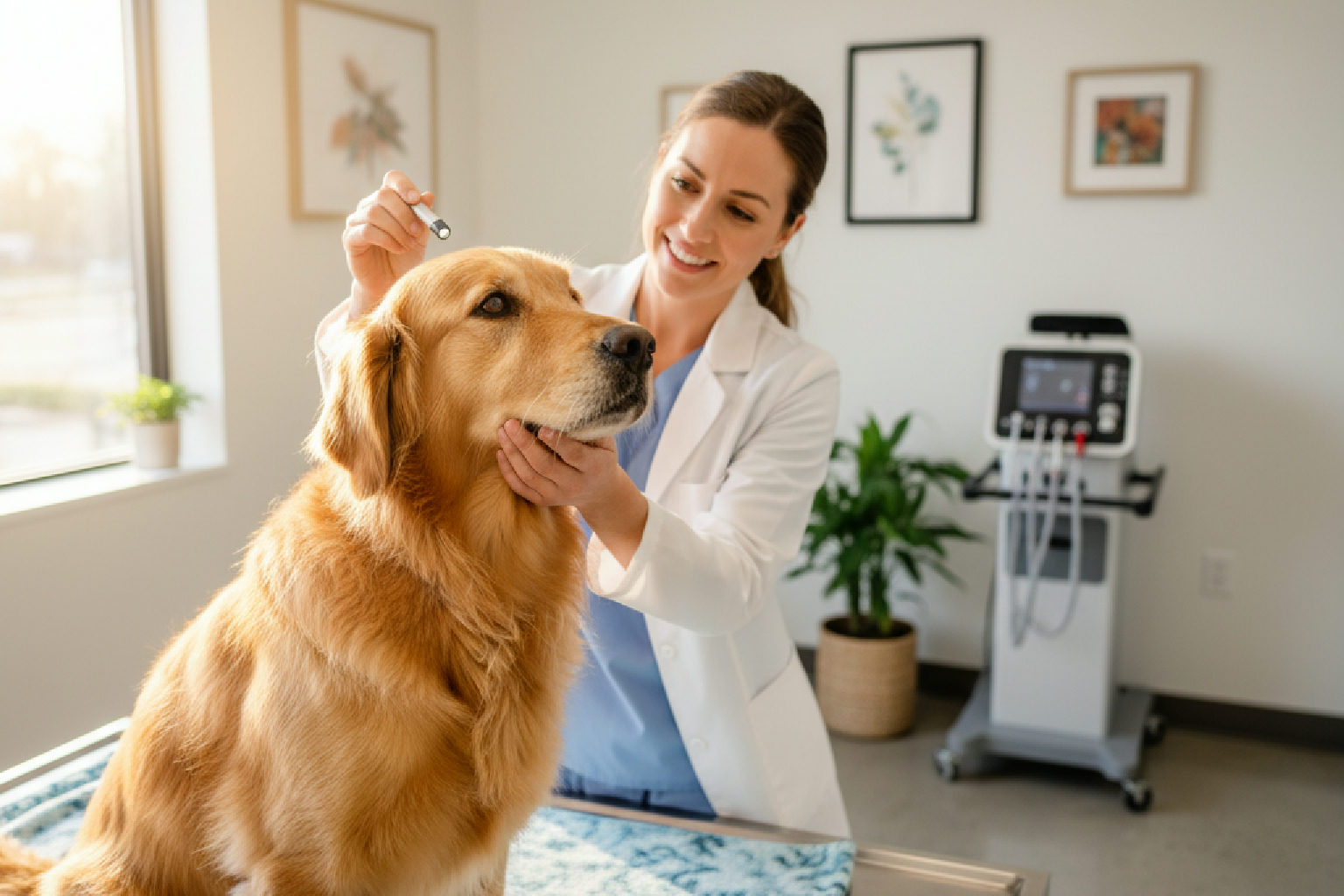
Diagnosis is usually straightforward. I can see the eyelid rolling inward on a standard ophthalmic exam. What takes more time is evaluating the cornea to determine how much damage has already occurred.
I'll use a fluorescein stain, which is an orange dye that glows green under a blue light. It sticks to damaged areas of the cornea, showing me exactly where ulcers or abrasions are. If there's an ulcer, we need to treat that aggressively while we plan for surgery.
I also check for dry eye (keratoconjunctivitis sicca) using a Schirmer tear test. Dry eye can worsen entropion or be the underlying cause of spastic entropion. If tear production is low, that changes the treatment plan. For more on dry eye, see our article on why your dog's eyes look red and goopy.
How do veterinarians fix entropion?
The definitive treatment for entropion is surgery. Medical management (lubricating drops, treating ulcers) can keep the eye comfortable temporarily, but it doesn't fix the structural problem. The lid will keep rolling in until it's corrected surgically.
Temporary tacking (for puppies)
In very young puppies, I sometimes use a temporary procedure called eyelid tacking. This involves placing a few sutures to evert (roll out) the lid margin without removing any tissue. The goal is to protect the cornea while the puppy's head continues to grow.
Why not just do the full surgery right away? Because a puppy's facial structure changes dramatically. A Shar-Pei at 10 weeks has a very different head than it will at 8 months. If we do permanent surgery too early, we might over-correct or under-correct. Tacking buys time.
Some puppies need tacking repeated once or twice before they're ready for permanent correction. Others outgrow mild entropion entirely as their head matures, though this is uncommon in severely affected breeds.
Permanent surgical correction
Once the dog's head is mature (typically around 6 to 12 months, depending on breed), we can do the definitive repair. The procedure is called a blepharoplasty or, more specifically, a Hotz-Celsus procedure for entropion.
Here's how it works: I remove a crescent-shaped piece of skin and muscle from just below (or above, for upper lid entropion) the affected eyelid margin. When I suture the incision closed, the tension pulls the lid margin back to its normal position, so it no longer rolls inward.
The amount of tissue removed depends on how severe the entropion is. This is where experience matters. Remove too little and the entropion persists. Remove too much and you create ectropion (the lid rolls outward instead), which causes different problems.
Surgery is done under general anesthesia and typically takes 20 to 45 minutes per eye. Most dogs go home the same day with an E-collar to prevent rubbing and eye drops to keep the cornea lubricated and prevent infection.
What about severe cases or unusual anatomy?
Some dogs, especially Shar-Peis with extreme facial folds or giant breeds with complex eyelid anatomy, may need referral to a veterinary ophthalmologist. These specialists perform more advanced procedures and handle cases where the anatomy is unusually challenging.
I'm comfortable with straightforward entropion repairs, but I'll always tell you if your dog's case is one that would benefit from a specialist's hands.
What does entropion surgery cost?
At most general practices, entropion surgery runs between $500 and $1,500 per eye, depending on severity and whether additional procedures (like treating a corneal ulcer) are needed. Specialist ophthalmologists typically charge $1,500 to $3,000 or more per eye.
If both eyes need surgery and there are no complications, expect to be in the $1,000 to $2,500 range at a general practice for the full procedure. Pre-surgical bloodwork and post-operative medications add to the total.
This is one condition where delaying surgery to save money usually costs more in the long run. A corneal ulcer that progresses to a descemetocele (a deep ulcer threatening to rupture) becomes an emergency that may require a corneal graft. That's a $2,000 to $4,000 specialist procedure, plus the entropion still needs to be fixed afterward.
What's the recovery like after entropion surgery?
Most dogs recover well and quickly. Here's what to expect:
- E-collar (cone): Non-negotiable for 10 to 14 days. One good rub with a paw can rip out sutures and undo the entire repair.
- Swelling and bruising: Normal for the first 3 to 5 days. The eye area may look worse before it looks better.
- Eye drops: Usually an antibiotic drop 2 to 3 times daily for 7 to 14 days.
- Suture removal: I typically remove skin sutures 10 to 14 days after surgery. Some surgeons use absorbable sutures that don't require removal.
- Activity restriction: No rough play, swimming, or anything that might traumatize the surgical site for 2 weeks.
By 2 to 3 weeks post-surgery, most dogs are fully healed and comfortable. The relief is often dramatic. Dogs that have been squinting and tearing for months suddenly have wide-open, comfortable eyes.
Can entropion come back after surgery?
When surgery is properly performed on a mature dog, recurrence is uncommon. The success rate is above 90% for straightforward cases.
Recurrence is more likely if:
- Surgery was done before the head finished growing
- The initial correction was too conservative
- The dog has very loose facial skin that continues to change with age or weight gain
If entropion does recur, a revision surgery can usually correct it. This is another reason I prefer waiting until dogs are skeletally mature before doing permanent repair, even if it means tacking once or twice first.
What happens if entropion is left untreated?
Nothing good. The constant friction damages the cornea progressively:
- Chronic irritation and pain: The dog is uncomfortable every moment they're awake.
- Corneal ulceration: The surface breaks down. Ulcers are painful and can become infected.
- Corneal scarring (pigmentation): The body tries to protect the cornea by depositing pigment. This permanently reduces vision.
- Corneal perforation: In severe cases, the ulcer eats through the cornea entirely. This is an emergency that may cost the eye.
I've seen dogs referred after years of "chronic eye problems" that were actually untreated entropion the entire time. By then, the cornea is so scarred and pigmented that even after surgery, vision is permanently compromised. Early intervention prevents this.
If your dog has chronic eye redness, tearing, or squinting, especially if they're a predisposed breed, don't assume it's just "allergies" or "normal for the breed." Corneal ulcers from entropion can progress quickly.
When should you bring your dog in?
Schedule a regular appointment if you notice mild squinting, watery eyes, or suspect the eyelid margin looks abnormal. We can evaluate whether entropion is present and how urgent surgical correction is.
Get your dog seen soon (within a day or two) if:
- The eye is very red or swollen
- There's thick or colored discharge
- The cornea looks cloudy or hazy
- Your dog is holding the eye completely closed or pawing at it constantly
Seek emergency care if the cornea appears to be bulging, there's visible damage to the eye structure, or your dog is in severe pain and unable to open the eye at all. A ruptured corneal ulcer is a true emergency.
The American College of Veterinary Ophthalmologists has additional information on entropion if you want to read more about the condition from a specialist perspective.
The bottom line
Entropion is a fixable problem. The surgery is well-established, the success rate is high, and the improvement in quality of life is real. If your dog has been squinting, tearing, or rubbing at their eyes, especially if they're a breed prone to entropion, don't wait for a corneal ulcer to force the issue.
If you're in Cypress or Northwest Houston and your dog's eyes are looking irritated, schedule a visit at Hearthstone Animal Clinic so we can take a look. You can reach us at (281) 859-9244. Catching entropion early means a simpler surgery and a better outcome for your dog's vision.
Have a question about your pet?
Dr. Pelton and the Hearthstone team are here to help, the same day when it counts.
Get Your Pet Seen